

Blog
What is an RFID card?
- Access control: Permitting access to buildings or restricted zones.
- Contactless payments: Paying for goods or public transportation.
- Identification: Employee, student, or visitor badges.
- Other applications: Utilized in a wide range of applications, including electric vehicle charging, inventory management, library check-outs, and event ticketing.
- HID UltraCard CR80 Noco PVC Card
- Pre-printing student cards in Lahore
- How it works: The antenna embedded in the card harnesses power from a signal emitted by an RFID reader. This enables the chip to relay the stored information, which can subsequently be utilized to execute an action, such as providing access or facilitating a payment.
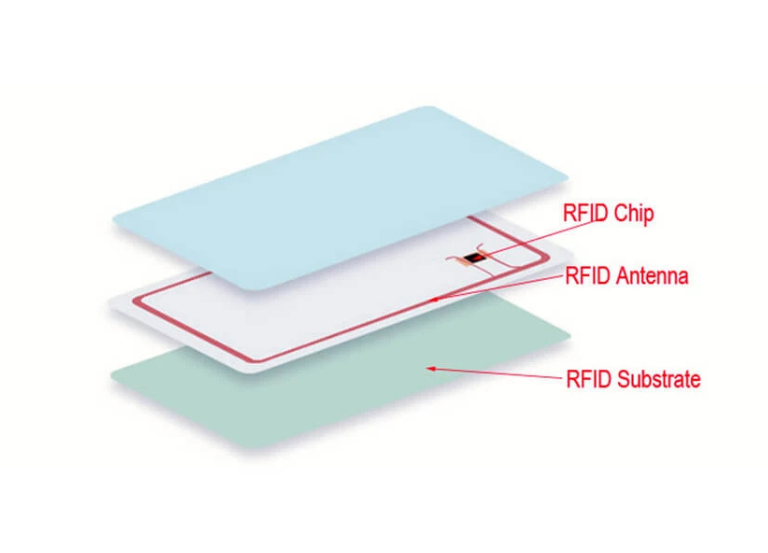
- Key components: An RFID system consists of an RFID card, which contains an embedded chip and antenna, along with a reader.
- Advantages: n contrast to conventional magnetic stripe cards, RFID cards do not necessitate a physical swipe or a direct line of sight for data retrieval. They also provide a more secure approach as the data is encrypted and can be accessed from a distance, rendering them challenging to duplicate.
- Common uses:
- Access control: Permitting access to buildings or restricted zones.
- Contactless payments: Paying for goods or public transportation.
- Identification: Employee, student, or visitor badges.
- Other applications: Utilized in a wide range of applications, including electric vehicle charging, inventory management, library check-outs, and event ticketing.
- HID UltraCard CR80 Noco PVC Card
- Pre-printing student cards in Lahore
An RFID card is a smart card that operates without physical contact, utilizing radio-frequency identification (RFID) technology to wirelessly store and transmit data through radio waves. It is equipped with an embedded chip and an antenna, serving various purposes such as secure access, contactless payments, and identification without requiring a direct line of sight. A specialized RFID reader can retrieve the data from the card from a short distance.
- How it works: The antenna embedded in the card harnesses power from a signal emitted by an RFID reader. This enables the chip to relay the stored information, which can subsequently be utilized to execute an action, such as providing access or facilitating a payment.
- Key components: An RFID system consists of an RFID card, which contains an embedded chip and antenna, along with a reader.
- Advantages: n contrast to conventional magnetic stripe cards, RFID cards do not necessitate a physical swipe or a direct line of sight for data retrieval. They also provide a more secure approach as the data is encrypted and can be accessed from a distance, rendering them challenging to duplicate.
- Common uses:
- Access control: Permitting access to buildings or restricted zones.
- Contactless payments: Paying for goods or public transportation.
- Identification: Employee, student, or visitor badges.
- Other applications: Utilized in a wide range of applications, including electric vehicle charging, inventory management, library check-outs, and event ticketing.
- HID UltraCard CR80 Noco PVC Card
- Pre-printing student cards in Lahore