

Blog
What is the difference between proximity card and iCLASS card?
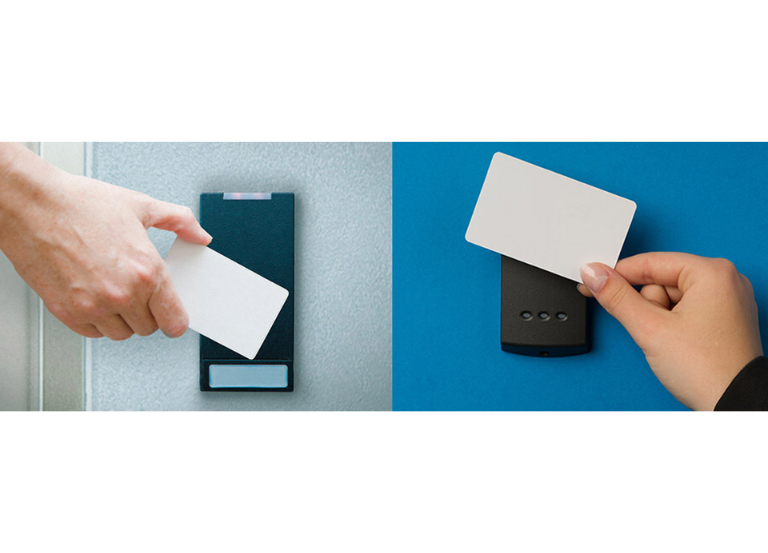
The difference between Proximity and iCLASS comes down to Frequency and Security. Think of Proximity as the “Legacy” standard and iCLASS as the “Modern Secure” standard.
-
The Core Differences
| Feature | Proximity (Prox) | iCLASS |
| Frequency | 125 kHz (Low Frequency) | 13.56 MHz (High Frequency) |
| Security | None. Sends a raw ID number. | High. Uses encryption and “Mutual Authentication.” |
| Data Type | Read-Only (Fixed ID number). | Read/Write (Can store biometrics/cash). |
| Cloning Risk | High. Can be cloned in seconds with cheap tools. | Low. Encrypted chips are very difficult to copy. |
| Best Use | Basic door access, budget systems. | High-security offices, Government, Payments. |
HID Proximity (The “Old School” Card)
These are the standard cards used for the last 30 years.
-
How it works: When you bring the card near a reader, the reader powers the card, and the card simply “shouts” its ID number (e.g., “I am Card #5001”).
-
The Weakness: Because there is no encryption, anyone with a $20 cloner from the internet can walk past you, scan your pocket, and create a perfect duplicate of your card.
-
Identification: Usually has a plain white surface or a “clamshell” (thick plastic) body. Often has the “HID” logo but lacks any specific technology branding like “iCLASS.”
2. HID iCLASS (The “Smart” Card)
Introduced to solve the security flaws of Proximity cards.
-
How it works: It uses Mutual Authentication. The card and the reader perform a “digital handshake” using encrypted keys. The reader says “Prove you are a real card,” and the card says “Prove you are a real reader” before any data is sent.
-
Capabilities: Unlike Prox, iCLASS cards have memory. You can store a template of your fingerprint directly on the card or use it as a “cash card” for office cafeterias.
-
Identification: Usually has the iCLASS logo printed on the card or box.
Compatibility Warning
They are not interchangeable. * A standard Proximity Reader cannot read an iCLASS Card.
-
A standard iCLASS Reader cannot read a Proximity Card.
However, many organizations use “Multi-Class” Readers (which have two antennas inside) so they can support older Prox cards while slowly transitioning employees to newer, more secure iCLASS cards.
Which one do you have?
If you are using the Fargo HDP5000 we discussed earlier:
-
If your card is iCLASS, you must ensure your printer has the 13.56 MHz Encoder module.
-
If your card is Proximity, you need the 125 kHz Encoder module.