

Blog
What is the difference between RFID and HID cards?
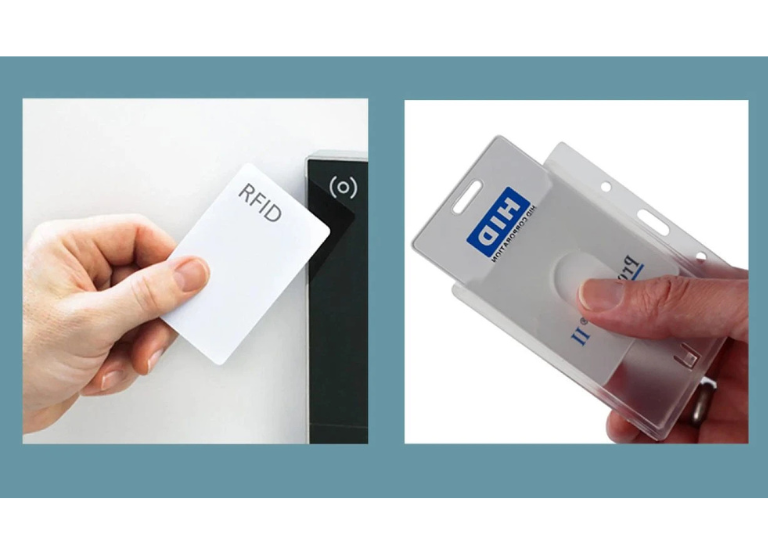
RFID (Radio Frequency Identification) represents a comprehensive technology utilized for tracking and access purposes, whereas HID is a particular brand that focuses on secure access control cards.
Typically, HID cards employ low-frequency (125 kHz) passive RFID technology, although they also provide high-frequency (13.56 MHz) alternatives for enhanced security.
Key Differences Between HID and General RFID Cards:
- Technology Scope: “RFID” covers various frequencies (125 kHz up to 960 MHz) and applications. “HID” refers to specialized, often proprietary, access cards (like Prox, iCLASS, Seos) designed for building security.
- Operating Frequency: Most common HID “prox” cards operate at 125 kHz (low frequency). General RFID cards often operate at higher frequencies (13.56 MHz, e.g., MIFARE), which allow for higher data storage and encryption.
- Security Level: Standard HID prox cards are generally less secure as they only send a card ID number. High-frequency RFID cards (including HID iCLASS/Seos) use encryption, making them more secure against cloning.
- Read Range: HID proximity cards generally work within a short range (2-6 inches). Other RFID technologies, such as Ultra High Frequency (UHF), can be read from several meters away.
- Versatility: HID cards are primarily used for physical access control. Other RFID cards have broader applications, including inventory management, payment systems, and transit.
In summary, HID cards are a subset of the wider RFID technology, specifically optimized for security, while generic RFID covers a broader range of frequencies and applications.